Root Canal Treatment vs Tooth Extraction: Which Is Better ?
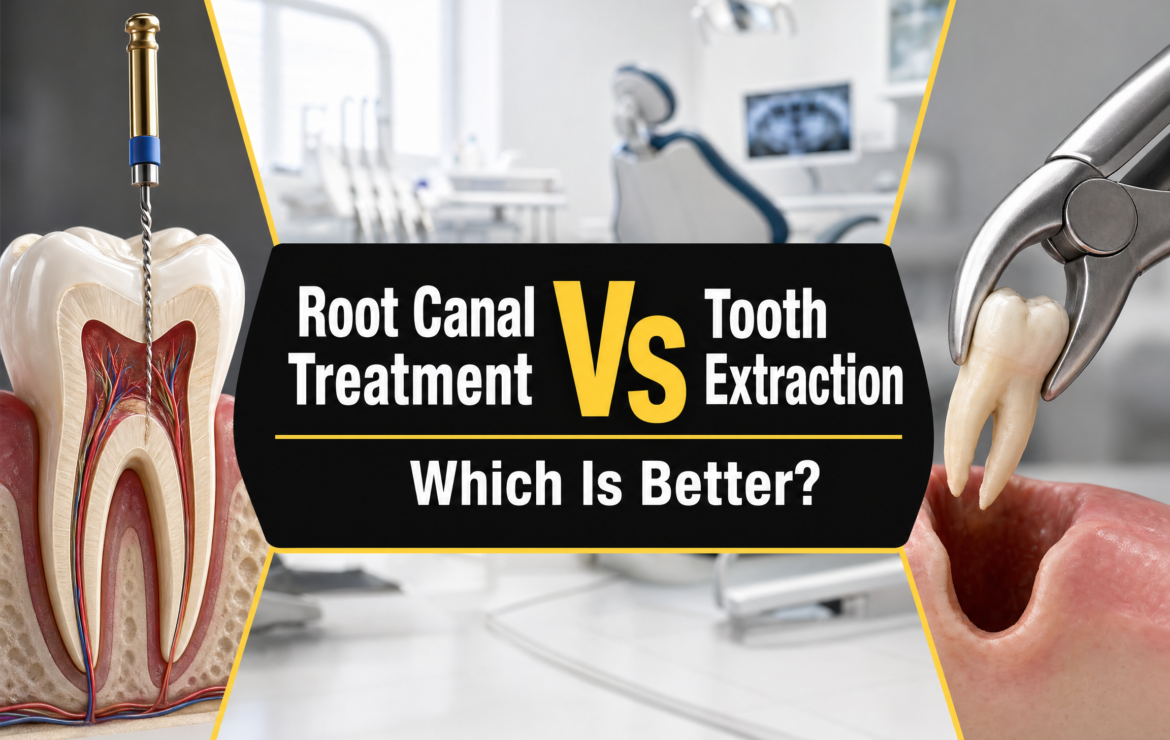
Root Canal Treatment vs Tooth Extraction: Which Is Better ?

Difference Between Root Canal and Tooth Extraction
- Root canal treatment removes infected pulp while preserving your natural tooth, whereas tooth extraction completely removes the damaged tooth from the jaw.
- In most cases, dentists recommend saving the natural tooth because it helps maintain bite alignment, jawbone strength, and long-term oral health.
- Although tooth extraction costs less initially, replacing the missing tooth with a dental implant or bridge can become significantly more expensive over time.
- Root canals typically involve faster recovery and less long-term discomfort, while extractions require healing time and carry risks like bone loss and shifting teeth.
- Severe tooth pain, lingering sensitivity, swelling, or tooth discoloration may indicate the need for root canal treatment before extraction becomes necessary.
When you are dealing with a severe toothache or a damaged tooth, the priority is to find relief and restore your smile.
At D’Arcy Dental, we often see patients facing a difficult choice: should they save the tooth with root canal treatment or simply have it pulled?
Both options have their place in modern dentistry, but the decision depends on the condition of your tooth, your long-term health goals, and your budget.
This guide will help you understand the differences to make an informed choice.
What Is Root Canal Treatment?
Often referred to as root canal therapy, this procedure is designed to save a tooth that is severely decayed or infected.
Inside every tooth is the “pulp,” which contains nerves and blood vessels.
When this pulp becomes infected due to deep decay or injury, it causes intense pain.
During the procedure, a dentist or root canal specialist (endodontist) removes the infected pulp, cleans and disinfects the internal canals, and seals the space with a biocompatible material.
Usually, a crown is placed afterward to restore the tooth’s strength.
What Is Tooth Extraction?
Tooth extraction is the complete removal of a tooth from its socket in the jawbone.
While dentists always prefer to save natural teeth, an extraction may be necessary if the tooth is fractured below the gum line, has severe bone loss from gum disease, or is too decayed to support a filling or crown.
Root Canal vs Tooth Extraction – Key Differences
The fundamental difference lies in preservation.
A root canal keeps your natural tooth structure intact, maintaining the natural alignment of your bite.
An extraction removes the tooth entirely, leaving a gap that must eventually be filled to prevent other teeth from shifting.
Which Is Better?
In the vast majority of cases, saving your natural tooth is the superior option.
Your natural teeth are stronger and function better than any artificial replacement.
However, if the tooth’s structure is compromised beyond repair, an extraction becomes the “better” choice to prevent the infection from spreading to the jaw or bloodstream.
Cost Comparison in Canada
In Canada, the upfront cost of root canal treatment is higher than a simple extraction.
Root Canal: Depending on the tooth (molars are more expensive), costs typically range from $800 to $1,500.
Extraction: A simple extraction may cost between $150 and $400.
While extraction is cheaper today, it leaves a gap.
To prevent long-term issues, you will need a dental implant or bridge, which can cost between $3,000 and $5,000.
When looking at the total cost of restoring your smile, a root canal is often the more economical long-term investment.
Pain & Procedure Comparison
Many patients fear the “pain” of a root canal, but modern technology and local anesthetics make it no more uncomfortable than getting a deep filling.
| Feature | Root Canal Treatment | Tooth Extraction |
|---|---|---|
| Anesthesia | Local anesthesia (numbing) | Local anesthesia (sedation optional) |
| Sensation | Pressure, but no sharp pain | Pressure and a “tugging” sensation |
| Procedure Time | 60–90 minutes (1-2 visits) | 20–40 minutes |
| Immediate Relief | Removes the source of infection | Removes the source of infection |
Recovery Time Comparison
Root Canal: Most patients return to work the same day. You may feel some tenderness for 2–3 days, which is easily managed with over-the-counter pain relievers.
Extraction: Recovery is more intensive. You must manage a blood clot in the socket to avoid “dry socket.” Full healing of the gum tissue takes 7–10 days, though bone healing takes months.
Long-Term Impact on Oral Health
Keeping your natural tooth maintains the stimulation of the jawbone.
When a tooth is extracted and not replaced, the bone in that area begins to resorb (shrink) because it is no longer being “exercised” by chewing forces.
This can eventually lead to a sagging facial appearance and the shifting of adjacent teeth.
When Do You Need a Root Canal?
- Persistent, throbbing tooth pain.
- Sensitivity to hot and cold that lingers.
- Swelling of the gums or a “pimple” on the gum line.
- Darkening or discoloration of the tooth.
If you experience these symptoms, visiting an emergency dental clinic immediately can mean the difference between saving and losing the tooth.
When Is Tooth Extraction the Better Option?
- The tooth has a vertical crack that extends into the root.
- The tooth is too weak to support a crown.
- Advanced periodontal (gum) disease has destroyed the supporting bone.
What Happens If You Don’t Replace an Extracted Tooth?
If you choose extraction and do not get an implant or bridge, the surrounding teeth will begin to tilt into the empty space.
This creates “food pockets” that increase the risk of decay and gum disease in your healthy teeth.
It can also lead to TMJ (jaw joint) disorders due to an uneven bite.
Expert Insight
Clinical data supports the high success rate of tooth preservation.
According to the American Association of Endodontists (AAE), approximately 25 million root canals are performed annually with a success rate of up to 95%.
Furthermore, statistics from various health studies indicate that patients who retain their natural teeth have better nutritional intake and higher overall quality of life scores compared to those with multiple missing teeth.
Root Canal vs Extraction – Pros & Cons
Root Canal Treatment
- Pros: Keeps natural tooth; prevents bone loss; avoids shifting teeth.
- Cons: Higher initial cost; requires a follow-up crown.
Tooth Extraction
- Pros: Low immediate cost; quickly removes a problematic tooth.
- Cons: Leads to bone loss; requires expensive replacement (implant); longer recovery.
How to Decide the Right Treatment for You
The best way to decide is through a digital X-ray and a clinical exam.
At D’Arcy Dental, we prioritize conservative dentistry—meaning we do everything possible to save your natural teeth.
However, we will always provide a transparent assessment if an extraction is the safer path for your health.
FAQs
Is it better to get a root canal or extraction?
Generally, it is better to get a root canal. Saving your natural tooth preserves your bite, prevents bone loss, and avoids the need for more complex prosthetic replacements later.
Is a root canal more painful than extraction?
No. Both procedures are performed under local anesthesia so you feel no pain during the process. However, the post-operative recovery for an extraction is typically more uncomfortable and takes longer than a root canal.
Which is cheaper, root canal or extraction?
An extraction is cheaper in the short term. However, when you factor in the cost of a dental implant or bridge to replace the missing tooth, a root canal is significantly cheaper over your lifetime.
How long does a root canal last?
With proper oral hygiene and a high-quality crown, a root canal-treated tooth can last a lifetime.
Do I always need an implant after extraction?
While not “mandatory,” it is highly recommended. Without an implant, your jawbone will deteriorate and your other teeth will shift, potentially leading to more tooth loss in the future.

Dr. Tejas Patel
Dental Specialist
Dr. Tejas Patel is a passionate dentist dedicated to providing patient-focused care with a gentle approach. A dentistry graduate of 2012, he has been practicing in Calgary since 2017 and offers treatments including crowns, root canals, extractions, bone grafting, and TMD care. He is known for his empathetic nature and focus on educating patients for long-term oral health.
Related posts